USMC - 2161 Machinist from 2004 - 2012
This blog post marks my eight years of active service in the military. People join for many reasons—tradition, calling, court orders, financial struggles, amazing educational opportunities, adrenaline, draft, or even events like 9/11, which I watched live on the high school TV. My journey began in the shadows—as a support Marine and machinist—trying to rise above a broken, single-parent household. I sought something different, forging my path with my own hands and meeting souls whose stories ran as deep as mine. I crafted, connected, and survived some wild experiences. I hit rock bottom and was even sent to the brig. How it all ended remains cloaked in mystery, but from raw recruit to dependable Sergeant, I faced the relentless sword of fate under the unforgiving UCMJ. Transitioning to civilian life? It was a mirror reflecting my childhood—a process of understanding the events shaped around the people who often pretended the most.
Why I Joined the Marine Corps
Family Inspiration: A Legacy of Service
Growing up, my sense of duty didn’t start in boot camp — it began in my grandfather’s basement in Atlanta. He was a World War II paratrooper and engineer, a man whose brilliance filled every corner of his home. When I was young, he visited my school as a guest speaker, bringing relics from his service — notes, photos, guns, a bayonet, sand from distant shores, and even a blood-stained flag covered in signatures that brought him to tears. He shared stories of parachuting behind German lines to locate enemy communication cables, and how he later had his silk parachute sewn into a dress for my grandmother, Peggy.
His home was a world of invention and wonder. While family life unfolded upstairs, I’d slip away to the basement — a place of planes, trains, and gadgets — with a pocket full of powder candies that turned to chalky sugar as sunlight filtered through the cinderblock windows. That basement was my first glimpse of craftsmanship, curiosity, and quiet purpose.
My father, Skipper — Orville Virginius Scott III — didn’t serve, but he carried that same spirit of care and responsibility, helping his mother alongside his sister when the basement became an in-law suite. The neighborhood itself felt magical, full of small adventures and childhood moments that shaped how I saw the world.
Those memories, and my grandfather’s stories, planted something in me — a respect for service, for creation, and for legacy. They became the quiet foundation beneath my decision to wear the uniform.
I didn’t come from a picture-perfect home. A terrible divorce in middle school, a single-parent household in a bad way. High school was rough in its own way—awkward moments, a fake prom date that should have declined but turned into another humiliation ritual. Lovebomb crush who had a boyfriend and never mentioned him until I asked her to dance at prom... maybe it was the white tux and sunburn from a USMC Delayed Entry Field event... lol. The kind of social chaos that sticks with you longer than it should, and it turns out some of it was by purposeful intent and social encouragement.
College didn’t feel like my path at the time, nor staying in Kennesaw in a girlfriendless neighborhood watched over by April & Henry. One day in the cafeteria, Qais and I were eating when a Marine recruiter in his dress blues was posted up near a display table. He was moving around most of the time, talking with people, but at some point, Qais and I ended up in a conversation that turned into a bet: he didn’t think I’d actually join. When lunch was over, I grabbed as much information from that table as I could while the recruiter wasn’t looking and spent the rest of the school day reading through it and thinking. Qais joined the Marine Corps shortly after I did and was an early inspiration into tech beyond the surface level for me. His friendship and family were always polite, and Qais was the type of guy who called people out when needed. If you were in need, he was there for you. I met him in middle school and became friends through high school.
In middle school, his accent and language depth got him picked on, which usually resulted in that person getting beat up. Do you remember or know of LAN parties? Qais and his family hosted some of the best. Qais was usually the one troubleshooting issues whenever one of the gamers’ computers wouldn’t cooperate, and when he was on Quake, he had an insane frag count. Through his tough shell, though, he has one of the greatest minds that I was lucky enough to know at an early age. We didn’t ship to boot camp together—that would’ve been a blast.
That same evening, when I grabbed the USMC promo materials, April came home and noticed the packets. I’d already told her I had no interest in college, and she made it simple: either go to school or leave her house on Scarlett Lane in Kennesaw, Georgia. That same house I later helped pay off so it could be sold and used as a down payment on another home in Sugar Valley, Georgia—also one I bought. That night, around 9 p.m., she drove me to the recruiter's station.
The recruiter ran me through some tests. I squeezed out maybe two pull‑ups. When he asked what field I wanted, I said infantry. He pointed to his knees, both in braces, and said “nope,” then handed me a list based on my ASVAB scores. Ordnance became my designated field. Around midnight, I signed the delayed entry paperwork. Weekly exercise, pre‑service knowledge, and a little structure before the real thing. My grades improved, my fitness improved, and I jogged around the neighborhood, bench‑pressing books added to the coffee table like they were iron plates.
Boot Camp – Parris Island
On 12 December 2003, at around midnight I had signed the paperwork that upon finishing High School, I would ship out to Parris Island from MEPS Atlanta. The bus ride was long and mostly quiet. At first there was some chatter between recruits, but as the miles rolled by and the air started to smell like swamp, the noise faded. Everyone knew something was coming, even if we didn’t know exactly what.
I was assigned to Platoon 1084. April mailed me what I’d asked for: a copy of The Art of War and an events calendar I probably wasn’t supposed to have. Boot camp was first and foremost an expertly crafted military regime, with a mix of fights, coordinated “behavior corrections,” bonds, suicide attempts, broken bones for some, mental breakdowns, failures, guest drill instructors, and a Senior Drill Instructor who had to leave the field. We had a Kill Hat who was deadly serious and Staff Sergeant Benjamin, who went from being a straight-up assassin to one of the greatest military disciplinarians I’ve ever seen when he stepped into the senior role. Our platoon received back-to-back awards—and the punishments that came with them.
Honestly, I had a great time.
Graduation came on a misty, cool morning. The entire battalion marched out of the fog onto the drill field. On 6 July 2004, I earned the title: United States Marine.
MCT – Learning the Basics
After boot camp, Marines either head to the School of Infantry or Marine Combat Training. As a support role, I went to MCT—and it was a blast. Guns, C4, communications, navigations, medical, grenades, and co‑ed Marines who taught you that “primal scent” is universal when nobody’s had a proper shower in a while.
Somewhere in that cycle, a special operations group rolled through and took over a range for a while. We were still in the crawl‑walk‑run phase, learning the basics, while they were working backwards from run to walk—smooth is fast. They talked with us for a bit, and it was a glimpse of what professionalism at that level looked like.
When MCT wrapped up, we were loaded onto transport and sent to our MOS schools. That’s where I learned I’d be a 2161 machinist. I had no idea what that meant or what 0.001" really was, but I was about to find out in Aberdeen, Maryland.
MOS School – Aberdeen Proving Ground
Aberdeen Proving Ground became home for nearly half a year. There, I learned to fabricate parts from a variety of materials using lathes, mills, hand tools, measuring tools, creativity, and resourcefulness. The class was small—just four Marines, a handful of sailors, and some Air Force. It was an incredible environment to grow in.
I was young and “free,” a young Marine figuring things out. I dated an Air Force machinist for a while. We stayed in hotel rooms or snuck into rooms, testing our stealth skills against guards—or maybe just their indifference. I graduated top of the class and was promoted to PFC (E‑2).
My roommate was an Amish Marine, and he was a trip. Same age as me, but with a lifetime of experience and wisdom that showed up in the way he talked and handled things. He could go full “hick” in seconds and drop humor exactly when it was needed. Our instructors were top tier. We had three dedicated to Marine machinists, including a black belt instructor for the MCMAP program who flew around teaching and enjoyed demonstrating moves on us that made us tap out for instructional purposes.
They drilled into us that safety comes first. The machine and fabrication shop is a serious space, and thanks to their standards, no one was seriously injured.
Japan – A World Away
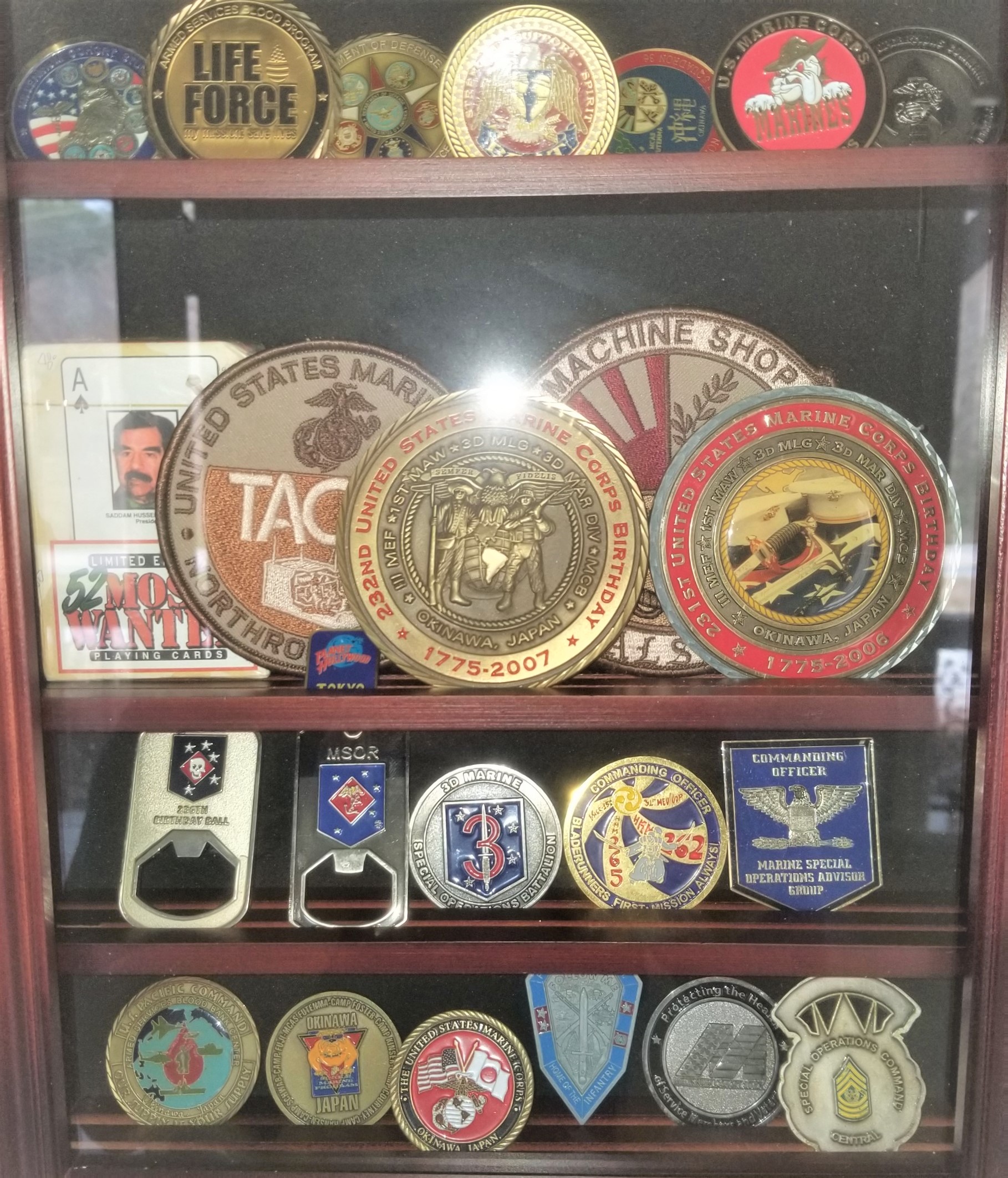
For my first duty station, I chose Okinawa—and got it. The flight was long, around twelve hours in the air, and the orders were for 24 months. Eventually, I made it to MCAS Futenma, my new home.
The barracks were old concrete buildings with the basics: bed, shower, toilet. The Marine Corps standard: be thankful for what you have. But the view over the ocean was superb. One day, someone jumped from the fourth floor window; we believed they died. Barracks life in Japan was field days, inspections, and work.
I worked across the flightline at Marine Aviation Logistics Squadron 36, supporting fixed and rotary‑wing aircraft. The machine shop was small—one Bridgeport mill and one South Bend lathe—attached to a larger airframes shop with hydraulics, non‑destructive inspection, welders, fiberglass, and more. I had some amazing mentors.
Eventually, I became the only machinist on the flightline, running the shop, keeping all tools accounted for, and completing most projects. Only one job needed help from the Air Force CNC shop. I learned to build computers, earned a gold card that removed my curfew, and got a driver’s license that let me explore the island outside of walking, biking, hiking, bussing, taxis, and drive some incredible vehicles.
There was a unique creative satisfaction in taking a blueprint or broken part and making a new one so the mission could continue. I met officers and pilots whose aircraft depended on parts I machined. I extended for another year, staying a total of three years in Japan, and re‑enlisted there. Eventually, though, I had to leave and take the long flight back to the States. Adjusting to the East Coast took some time.
North Carolina – Camp Lejeune & MARSOC
Back in the States, I was sent to MSOAG, the Marine Special Operations Advisor Group at Camp Lejeune. There was no machine shop at first, so I filled a variety of billets. They placed me in the armory, where I learned alongside 2112 weaponsmiths and 2111 armorers. Eventually, I was given my own “cage”—team weapons, modifications, gear, ordnance—and maintained 100% accountability. The machine jobs I were given were mostly bolt removals and on odd occasion a message would come out to modify weapons or equipment that the 2112's (Marine Corps Specialized Gunsmiths) would give to me in between them glassing rifles.
During this time, I swam a lot at the pool and became WSQ/CWS1, bought a Honda CBR600RR for unit rides, met a lot of good people, and pushed myself physically and professionally. I became MCMAP Brown Belt certified, a seven‑time rifle range expert, pistol sharpshooter, and a foreign weapons instructor between Camp Lejeune and Fort Bragg SWICC armories.
The unit eventually changed names to 3rd MSOB under the MARSOC banner as the regiment stood up. I was there for the ground breaking. But alongside the good, there was trouble. A theft ring was operating, and while I knew some of the players and tried to keep my distance or stay cordial, I kept my mouth shut. Eventually, I became a target in a unit investigation and NCIS case.
It was described as a hub‑and‑spoke conspiracy: an officer at the center, with multiple spokes doing legal and illegal things for a larger scheme. I was associated with one of those spokes and my knowledge was leveraged against me as I just went with the flow unbenwonst to me that many of them were already under investigation, on camera with stolen items. I never participated in 99% of what they had going on, they were basically taking military items and selling them to undercover officers. I was charged with many things and eventually found guilty on a single charge of conspiracy. I tried to fight the charges at court‑martial but the case shifted mid‑discussion with my first military lawyer. I hired a civilian attorney off base who minimized a lot, but because I’d written that confession, they had me for conspiracy. That’s the charge I received.
The judge reduced me to Private and sent me to the brig, leaving the door open for reenlistment. My Gunny whom I had butted heads with a few times over his treatment of Marines fast‑tracked an administrative separation the judge hadn’t ordered. I was punished twice. The brig was its own world—one I’ve written about separately—and it affected me for years. I ended up with two enlistment periods: one General, Under Other Than Honorable Conditions, and one Honorable Discharge. 3 Good Conduct Medals in 8 years of Service.
A Quiet Hope for Whoever’s Reading This
My career in the Marine Corps was great, and I regret getting out the way I did. I want to challenge that outcome someday, when finances allow. In 2010, things got dark. My dad passed away under odd circumstances, and I was already drinking heavily, thinking it was just part of Marine culture. Those two forces—grief and alcohol—did not mix well.
I remember a very dark night with a bottle and a gun. Staff Sergeant Miller, my boss at the time, saw something at work and pulled me aside. He’d clearly been through something similar; you only recognize that kind of weight in someone else if you’ve carried it yourself. He told me, “If you ever feel like hurting yourself, don’t. Hurt those that caused the pain. You only hurt those that care about you.” It wasn’t a perfect message, but it was enough to interrupt the spiral.
Shortly after, our officer signed me up for a new Suicide Prevention Training program the Marine Corps was rolling out. I flew around the United States, educating MARSOC units on resources, examples, and real‑world experience. I became a Suicide Prevention Master Trainer.
This page isn’t here to glorify anything or to ask for sympathy. It’s here as a record: of choices, consequences, growth, and the reality that a career can be both honorable and complicated. If you’re reading this, whether you’re a Marine, a veteran, or just someone browsing, I hope you find something useful in it—whether it’s a warning, a bit of encouragement, or a reminder that you’re not the only one trying to make sense of your own story.
Fitness ReportsProof of Service
Starting at Sergeant (E‑5), Marines receive fitness reports—formal performance evaluations. Below are five of mine, with sensitive information redacted and documents flattened to prevent tampering. They’re here as transparent proof of the work I did and the standards I was held to.
Pre-Trial Investigation, Court martial & Failed run-time PFT, short notice, no acclimation time (MCO 6100.13A CH-2) returning to Summer East Coast after CNC school in California fitness report
Images & Visuals